Lingbo Li
The Origins of a Foodie
For a foodie, I had a spartan culinary upbringing.
Perhaps it began in utero, when my mother ate tomatoes by the bushel during her pregnancy, believing it’d lead to a smarter child.
Out I came, eight pounds of screaming joy, born to China’s new breed of post-Cultural Revolution, university-educated brethren. Becoming American was an unlikely reinvention for my father, whose family, up until a few years ago, lived in a two-room concrete building heated by a coal furnace. Chickens still roamed the dirt roads.
My family held onto every dollar, never forgetting how difficult they were to come by. While my father was a Ph.D. student, we rented the top floor of an old house in upstate New York, wearing jackets indoors to save money on heating and faithfully finishing the leftovers.
I didn’t feel so different from other kids back then.
In elementary school, I qualified for a free school lunch, and I ate the same food as everyone else. Later on, my mother would pack strange lunches—fried rice with oil leaking out of the takeout container—and I remember feeling ashamed as I saw how my classmates’ lunches were so sterilized and scentless, so perfectly contained and uniform.
My parents did their best, and for the most part, I was very happy with what I had to eat. I never went hungry, and I did like my mother’s unambitious but earnest Chinese home cooking. When we wanted to celebrate, we would predictably choose one of the all-you-can-eat Chinese buffets nearby, no matter what the occasion. The $12.95 price tag seemed exorbitant at the time.
As I got older, the feeling of being different grew.
Meet Felice, Creator of the World’s First Linux Birthday Cake
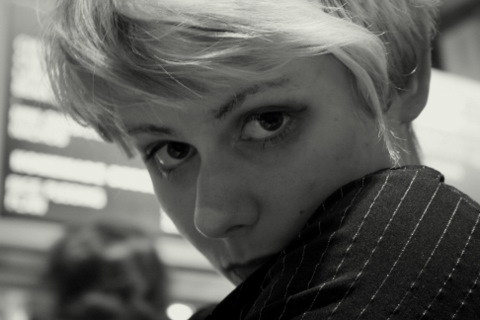
My roommate Felice is neither a typical Harvard student nor a typical pastry maker. When I first saw her, she was powder pale, with a green mohawk, combat boots, and no eyebrows. This will be interesting, I thought. Maybe we can do each other’s makeup.
We lived together entirely by accident – my roommate and I at the time were looking for some more people to make a room of 5. She gamely agreed.
Felice turned out to be the brainy lovechild of a punk rock Betty Page and The Odyssey’s Homer. In between translating ancient Greek texts for her senior thesis and poring over orgo homework, she watched a constant stream of L-word spinoffs and brutal slasher flicks.
One day, she’ll be a surgeon, a programmer’s wife, and proud mommy of the cutest pet rats ever.
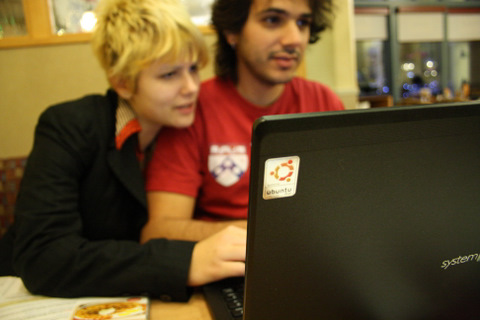
Felice and her boyfriend, Yuvi Masory, hacker extraordinaire
Felice ended up being my favorite roommate my strange, wild junior year. The five of us in that doomed rooming group were an unlikely melange of misfits – “a flophouse” she aptly described it – and it wasn’t long before chaos swept our cinder block duplex.
One by one, like an Agatha Christie mystery, the room fell apart.
One girl left, amidst a swirl of unanswered questions. And then there were four.
For the rest of us, latent problems became crises. Annoyances became vendettas. I was literally scared to return my room, and when I did, I locked the door and braced myself for collateral damage. By spring semester, the bickering reached a fever pitch.
I spent most of my semester either in class or hopping from one food event to another, spending more time in Boston in a month than most Harvard undergrads do in all four years.
And then there were three.
Felice ended up being the mediator; her room was the bunker, the common room was no man’s land. After she listened to everyone’s problems with saintly patience, we laughed about the black comedy unfolding. In between complaints, I wrote my anthropology essays in her room decorated with 50’s pinups and queer icons as she Skyped her long distance boyfriend.
In a school where people frequently hide their insecurity beneath a shiny veneer of ambition, Felice was refreshingly genuine about both. She didn’t dye her hair funny colors because of some calculated counter culture attempt. She just liked dying her hair.
And she understood, perhaps better than anyone else I’ve met, about what it means to feel profoundly, deeply different without apology. She was silly and joyful about her quirks and didn’t bother to hide them.
She doesn’t collect business cards. (While I have so many lining my tote bag.) She has the same insecurities like everyone else, but doesn’t fall to unwitting flashes of cruelty when she feels down. It’s refreshing.
So when she takes a stab at baking, it is infused with an equally individualistic sensibility.
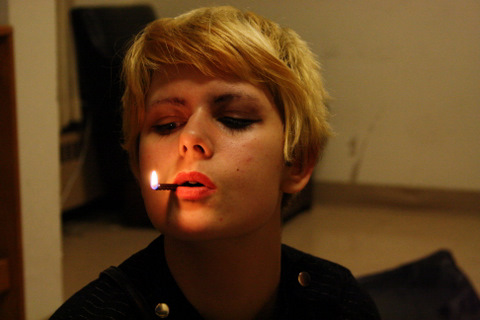
Yes, that’s a birthday candle betwixt her rouged lips.
For her programmer boyfriend’s birthday, Felice made her favorite stalwart Linux enthusiast a cake shaped like the operating system’s logo. Earlier, we had dropped by IHOP for dinner while he showed me his flashcard generator program, executable via the command line interface.

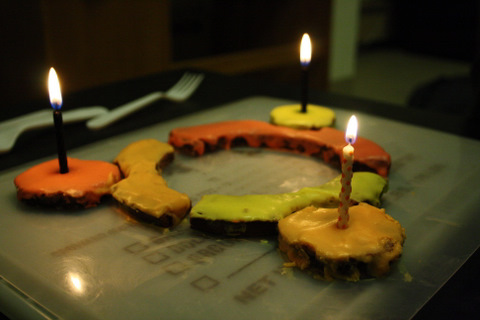
Different can be beautiful, and delicious.
Harvard’s First Molecular Gastronomy Dinner

I got a mysterious email a few weeks back form the executive chef of Harvard University Hospitality and Dining Services (HUHDS). Martin and I had met up before to talk about food events on campus, but this time, he had a different request – a special invitation to a very peculiar dinner.
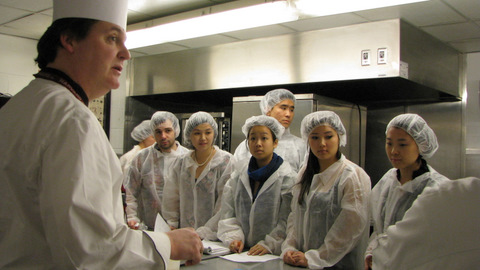
Courtesy of Dara Olmstead at HUHDS.
When I met up with Martin and the director of HUHDS, Ted Mayer, they handed me a sheet of paper that had the following menu printed on it:
IVY Plus Dinner at the Faculty Club
“Science & Cooking at Harvard”Beet & Orange Jelly
Science:- Gelatinization
***
Yogurt cheese w/ balsamic & olive oil sphere
Science:- Sperification
***
Chilled Cucumber & dill Cappuccino
Science:- colloid, foam
***
Porcini-dusted line caught Maine Cod
w/ asparagus puree & lobster foam
Science:- Dehydration
***
Pork belly w/ creamed polenta & BBQ sugar
Science:- Isomalt
***
Hot orange Sorbet w/ Campari Caviar
Science:- Methylcellulose
***
Chocolate Finale
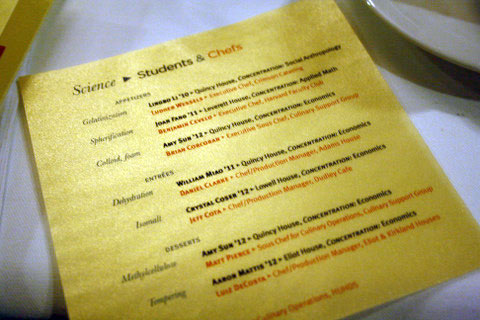
I had to admit, I was doubtful.
But Martin and Ted were both very excited about the top secret nature of the dinner – the guests, all Ivy League (and Stanford) food service professionals in town for a conference, were going to be kept in the dark about the nature of their dinner.
My mission was to recruit a handful of students in the class to do a science-laden explanation of each dish’s more technical components.
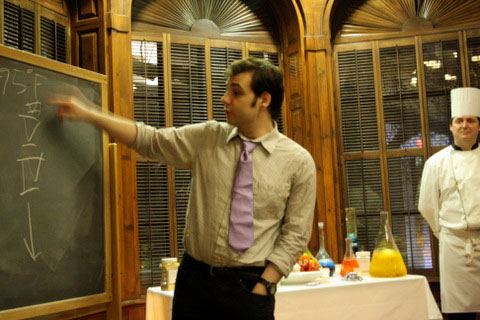
This menu does not reveal the full ambition of the dishes, nor the meticulously thought-through inspirations behind each, which came from top-flight kitchens around the world. Both of these men had eaten some very, very nice food in their lifetimes, and I could sense they were having a lot of fun with this magical practical joke they were playing.
For example, the beet and orange jelly came in a variegated slice, one side red, the other orange. But the trickery came in the flavors – yellow beets and blood oranges created the visual illusion that they had swapped shades.
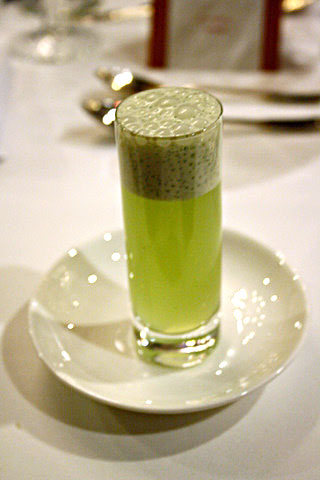
I roped 5 friends into participating and we did a tour of the kitchen where chefs were testing out their dishes. We noticed that the dill-infused foam perched atop the cucumber water in shot glasses were quickly melting from foam to liquid. My friend Amy, who’s doing a final project on stable foams, recommended adding some methocellulose (which also solidifies at high temperatures rather than low, yielding a dessert course of hot sorbet) to the mix.
They tried it, and like magic (or science), the foam remained high and frothy.
When the night of the dinner came, I was actually pretty beat – I had a computer science midterm the next day and wasn’t particularly hungry. But when I arrived in the faculty club, Martin and Ted’s enthusiasm quickly rubbed off.
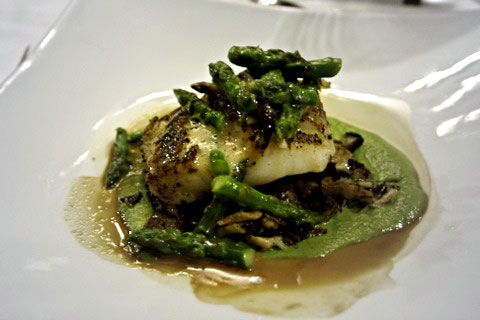
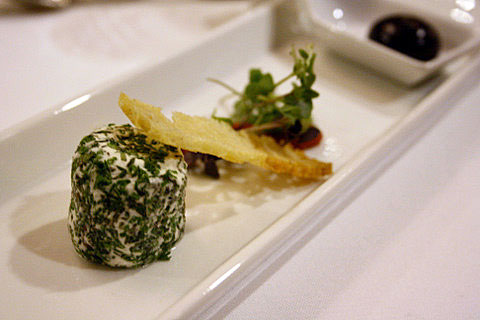
The first course came, the jelly – perfectly fine. Then the yogurt cheese with sphere of dressing – beautiful to look at and even more fun to crack the sphere to eat. A cool, clean shot of something vegetal. Then one of my favorite dishes, the porcini-dusted Maine cod with asparagus puree and lobster foam, in between sips of a crisp white wine which married beautifully with each bite. Pork belly came on marscapone cheese-laden polenta and a scientifically stable sugar topping infused with barbecue spices. Hot sorbet..
Then the chocolate finale, which my friend Aaron (we met interning at Serious Eats) introduced. For each course, my friends had all prepared explanations and equations to illustrate concepts like foams and gelatin. Aaron, who is a great speaker anyway, gave one of the most authoritative and entertaining lectures on chocolate I’ve ever heard.
The “finale” was the pop rocks embedded in the chocolate, which set off near-literal fireworks, a room of pop-pop-fizz.
A pretty amazing dinner, pulled off by the same people who are behind my daily dining hall meals. Who would have thunk?
And I did fine on my computer science midterm, so I hope I made Professor David Malan and all the lolcats in the world proud.
Hot Boston Restaurant Openings
Eater's Heatmap Image! Grr, spicy. (Courtesy of Eater)
I was honored to throw my two cents into this incredible, multipage-feature on hot Boston restaurant openings for Eater National by Gabe Ulla. It’s definitely worth a look if you’re jonesing for some studly new place hit up.
Why There’s No Such Thing as a Free Lunch

By Wilson Yu for FM
While I’ve been negligent in updating the blog recently, I’ve brought some some extra hands in the form of a smart, enthusiastic fellow student to help me out with what my spare brain can’t handle. Welcome Bianca!
And don’t forget: have you read my “Lingbo Eats” columns for The Crimson’s Fifteen Minutes magazine? They’re probably amuse you:
The Fallacy of the Free Meal: I explain, in far more color than Gregory Mankiw (star Harvard economist and totally huggable prof) why there’s no such thing as a free meal. Nay, dating. Nay, chemistry camp. True story.
Don’t Eat Yet!: Why I am possibly the most annoying dinner companion alive, and more importantly, how you can be, too!
The Maine Course: I’ll eventually write a proper blog post with pictures, but I visited Maine last month. This is a fast and dirty chronicle on how I put on 5 pounds in one weekend through superhuman exertion.
Lana Lingbo Li

I'm a world traveler / enthusiastic eater who's now blogging and producing videos over at HelloLana.com. Visit me there!
As Seen On