Lingbo Li
Olive oil gelato tonight at Taranta. Mmm.
 Today is Earth Day – which means you have an excuse to enjoy the five course prix fixe menu at Taranta in the North End. (Peruvian-Italian? I know, awesome, right?) I’m primarily plugging this because there’s olive oil gelato for dessert. Because they’re working with Carapelli, a Komen sponsor. I’ve never loved the idea of corporations getting in my food so much. I’m almost regretting my reservation to Oleana tonight. You’ll hear a verdict soon enough.
The deets:
$49.00
Requires participation of entire table
For reservations visit www.tarantarist.com
Photos from Spoonful of Ginger – MFA Boston
Despite how late this post is would indicate, Spoonful of Ginger (April 5) has been one of my favorite tasting events. A lot of (mostly) Asian food. In the gorgeous MFA. No brainer.
It was held to benefit the Joslin Diabetes Center’s Asian American Diabetes Initiative. Which meant endless, endless noshing in the good name of diabetes (although I’m not sure how a diabetic would fare if he were to shovel Flour’s chocolate dessert away). Using the MFA as its culinary space was also an interesting move that worked, with tasting split between the ground floor (classy) and the restaurant space upstairs (lively).
Ming Tsai had the longest line of people waiting for his hot and sour soup. When I mentioned this, he said, quite humbly, “It’s because it’s free!” Well, not free. But all you can eat, sure.
There were some really interesting dishes and presentations on display, like goji berry-topped spoonfuls of chicken aspic from Changsho or the adorable crab puff speared above a double shot glass of gingered shellfish consomme from Jasper White’s Summer Shack. Also ran into fellow food bloggers The Boston Foodie, Jackie Church, and Richard Auffrey while I was there.
Mumbai Chopstix opens on Newbury Street (Launch Party)
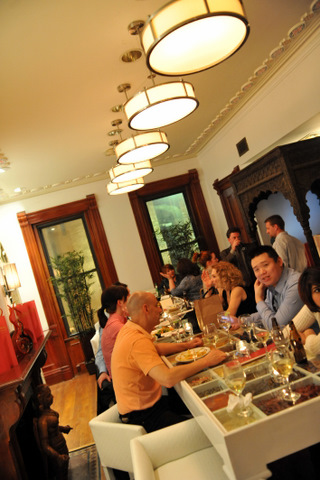
Newly launched Mumbai Chopstix (254 Newbury St, Boston), has a few identities.
One is its Indian-Chinese cuisine, very popular in India, yet seldom seen in Boston restaurants.
But I’m still not sure of Mumbai Chopstix’s true identity deep down. The logo and name suggests fast casual, but the space is very cool, even rather ambitious. The jury’s still out on the food, but their menu looks like a promising mix of classic Indian-Chinese dishes.
Based on their launch party edibles, I’ll hazard a few descriptions. In some cases, it was very close to American-Chinese food, like the glossy, cornstarch-thickened sauces on fried chicken and fried paneer, along with 5 incarnations of dumplings ranging from traditional Chinese to Chinese with heavy notes of coriander and cumin.
Most successful were the juicy Manchurian meatballs served on bites of naan bread, and a very traditional chili chicken was delicious, if skirting terribly close to General Tso’s chicken but dialing down the sweetness and tweaking the spice.
Lobster balls were not as lucky in the fusion process – they tasted entirely of starch, except for a fishy, lingering aftertaste. Vegetarian momos had far too heavy a hand on the spice. Oversized fried lollipop chicken was fine, as were the spring rolls (served with tamarind dipping sauce).
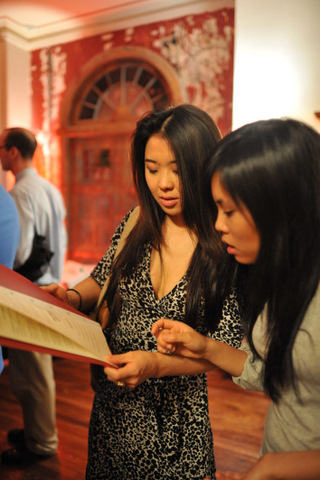
Perusing the menu with Lena (photo by Sam Lipoff)
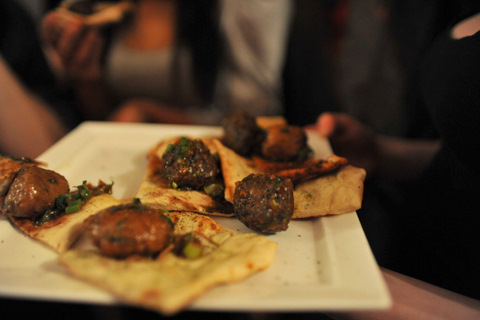
Manchurian meatballs with naan (photo by Sam Lipoff)
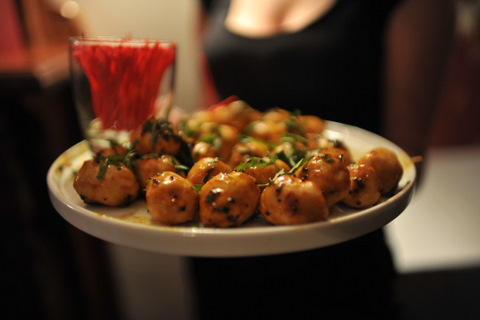
lobster balls (photo by Sam Lipoff)
Several Boston restaurants already feature classic fusion dishes – chili chicken is one – but this is the first restaurant to focus solely on the genre. It’s owned by One World Cuisine, the same people who put out Mantra, Mela, Bukhara Indian Bistro, and Cafe of India in Harvard Square.
But food aside, the space is a real draw. I wouldn’t mind setting up camp in their upstairs dining room, unmistakably a renovated living room. There’s the wooden staircase, a carved nook for the bar, a fireplace, a pot of ersatz bamboo; it feels very much like a dinner party in the home of your hip, successful artist friend.
And there’s the table, which boasts a rainbow grid of spices under its glass countertop. It pops with whole, dried red chiles, sticks of cinnamon, brilliant orange turmeric, garbanzo beans, the green of bay leaves. My friend was also entranced by the bar mural downstairs and tried to hire the maker to repeat it in her apartment.
Who knows how this cross-cultural marriage will turn out, but man, the couple lives in a nice house.’
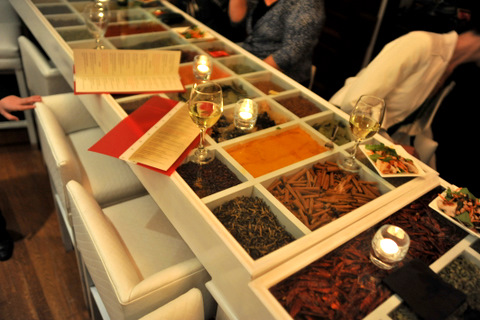
The table (photo taken by myself, with Sam's camera)

Golden Unicorn’s Dim Sum (New York City)
China is hustle. You remember all the aggressive salespeople in Shanghai, those doe-eyed shopgirls you hated so much. Last summer took so much sweat and yuan from you, in between being ripped off and drinking the cheapest beer at the most glamorous watering hole in the city.
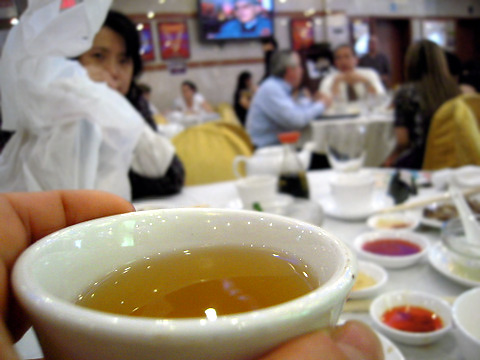
But it’s been nearly a year, and slightly off-kilter hum of dim sum being served at Golden Unicorn in New York City is nostalgic now. You almost miss China, or at least its edible bounty, and your friends who ran a hot pot restaurant.
Dim sum is endemic to that decompression zone of Hong Kong, where you spent a week the summer before last. Golden Unicorn is convincing – the carts clatter, the gold chair covers are frayed, you spill chile oil over the white tablecloth.
Never mind, here’s another saucer – or is that red vinegar?


When you order the duck feet, the server piles the bowl 5 high. The skin of the webbed toes are marvelous, cleanly giving way to the teeth like a sheet of bean curd. The joints are gelatinous, more like chicken feet. You eat a plate of those too, the tiny bones piling up before being cleared away by a woman with a severe bun.
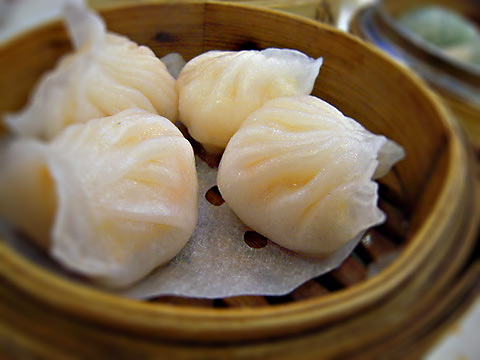
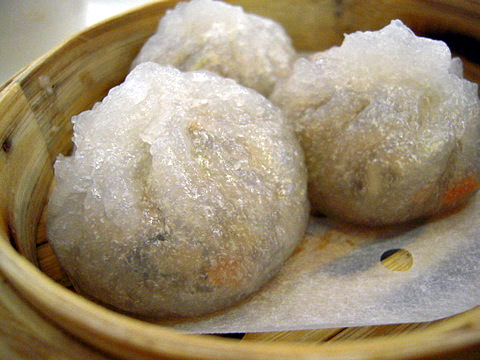
Laowai chatter over half-empty cups of tea while the tai tais thrust platters of egg tarts and steams of shumai for inspection. It is unclear who is laowai in this situation. These dim sum pushers are experts at their trade: this is very good, they say, proffering a quartet of crystal shrimp dumplings, assuming the sale. Before you know it, they’ve stamped a bleeding crimson star on your receipt. Thank god the dumplings are translucent, delicious. You count ten folds in the seam, short of the grand master’s twelve.
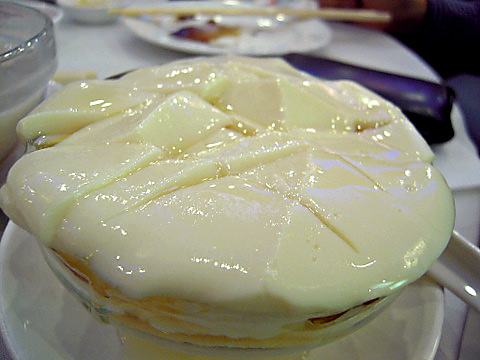
Dad orders do fu nao, a silken tofu soup sunk in a delicate, sweetened ginger broth. It glistens; it quivers. It is as gentle as lullaby and as slippery as sin.
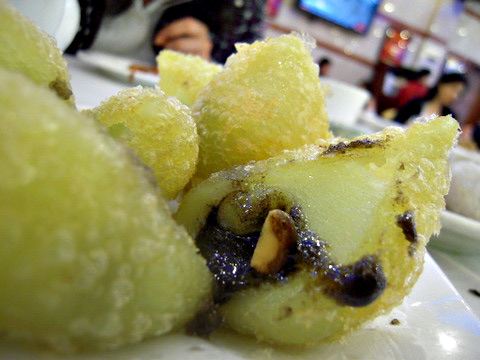
You read later that Golden Unicorn has dipped in quality since its glory days, but this is still some of the best dim sum you’ve had. There’s one dish, in particular. It’s fried sticky rice balls filled with a thin sesame paste and chopped peanuts. The dough is tinted emerald and the exterior is a golden spackle of tissue-thin crisp. Though sticky rice dough can often feel chewy and dense, this one is meltingly tender. After the server cuts them with her shears, the top is pointed, like a phoenix tear.
The bill is settled, and you linger for a ten or fifteen minutes. You feel your future scrutinized and decided. Your mother is happy; she rests her chin in clasped hands and gazes at you in a way that says, I might have grandchildren after all.
You drink deeply, then spoon obscene amounts of chile oil into the congee.

Lingbo cooks: General Tso’s Chicken
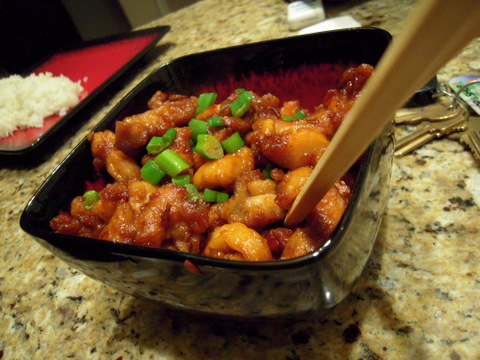
Mmm tastes like chicken.
In the vein of cooking all those greasy-chopstick takeout classics that so happily populated my childhood, here is General Tso’s chicken. I got the recipe from Fuchsia Dunlop’s Revolutionary Chinese Cookbook: Recipes from Hunan Province
I don’t own a deep fryer, so I had to shallow fry small batches of chicken. It was really, really awful. I ended up with oil covering everything in a two foot radius, along with being splattered several times. I even wore an unwieldy floral oven mitt on my left hand and a heat-resistant glove thing on my right, while wielding red tongs. I looked pretty ridiculous.
Didn’t have tomato paste, so made do with ketchup. It was a good call.
The finished product wasn’t half-bad. Sure, it didn’t quite have the thick, crunchy crust to accompany the sweet-savory sauce, but my shallow fry fared alright. For the culturally curious, Jenny 8. Lee investigated the mysterious origins of the famous General in her book, The Fortune Cookie Chronicles: Adventures in the World of Chinese Food

Lana Lingbo Li

I'm a world traveler / enthusiastic eater who's now blogging and producing videos over at HelloLana.com. Visit me there!
As Seen On